



A Designer's Guide to Specifying LED Strip Lighting
A lighting concept that looks strong on paper can fall apart at installation. If a few technical variables aren't accounted for at the specification stage, the result can be disappointing.
LED strip lighting in particular has details that do not surface until the product is on the wall: color consistency, dimming behavior, finish quality, and long-term reliability all depend on decisions made before the installer arrives.
These are the areas that most often determine whether a designer's LED strip concept delivers on its promise.
Color Consistency
Color consistency in LED strip lighting involves two distinct questions. The first is whether the strip produces the color temperature listed on the spec sheet. The second is whether that color temperature holds consistently across every strip in the installation.
CRI (Color Rendering Index)
This measures how accurately a light source renders the colors of objects in its beam. High CRI options, generally 90 or above, reveal true colors in materials, textiles, and skin tones. This matters significantly in spaces where the client has invested in the finishes. Furnishings and a curated color palette can be deeply altered by the CRI of the light source. A beautiful material rendered poorly under low-CRI light is a missed opportunity in any designed interior.
CCT (Correlated Color Temperature)
This is the Kelvin spec that determines how warm or cool a light is. Two 3000K strips from different manufacturers may look subtly different. More critically, strips from different production batches of the same product can vary slightly. For large installations or when two adjacent strip runs are simultaneously visible, making sure they come from the same production batch reduces the risk of visible color variation across the finished work.
Define your CRI and CCT targets early in the design process. Confirm both on the product data sheet before placing the order, and ask your supplier about batch-match availability when the installation is large.
Dimming Behavior
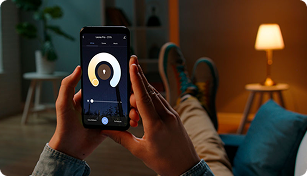
Smooth dimming from full brightness down to near zero isn't a default feature of every LED strip system. It depends on the compatibility between the strip, the driver, and the dimmer. A mismatched system can produce flickering at low dim levels, a narrow dimming range, or a sudden drop from dim to off before the control reaches zero.
This matters most in hospitality and restaurant applications. The ability to shift lighting across service periods is often central to the design intent. A dining room that dims gracefully from a bright lunch setup to an intimate evening setting is a much better outcome than one that flickers below 30% and cuts out before the dimmer reaches its lowest point.
Specify dimming capability as part of the full system. Confirm that the driver supports the dimming protocol the controller or dimmer uses. Verify that the strip performs consistently across the full range without flicker. These are short conversations at the specification stage, but are much longer conversations after the client reports a problem.
For applications that layer LED strip lighting with other fixture types, coordinate driver and dimmer specifications across the full lighting control plan rather than specifying each circuit independently.
Finish Quality
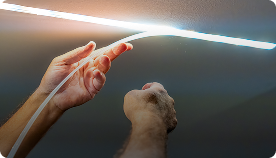
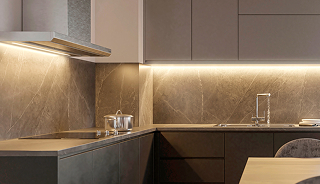
The finish of an LED strip installation is shaped by more than the strip itself. How the strip is mounted, which channel profile it is in, and whether the output is diffused or exposed all affect how the installation reads in the finished space.
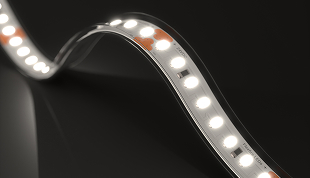
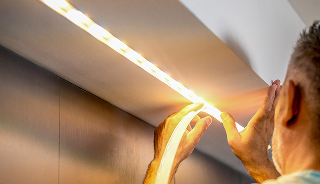
A strip installed without a mounting channel leaves the diodes, substrate, and wiring visible. In most interior applications, this reads as incomplete. Mounting channels contain the strip, protect it from damage, direct the light output, and allow for clean terminations at the ends of runs. They're a specification item, not an optional add-on.
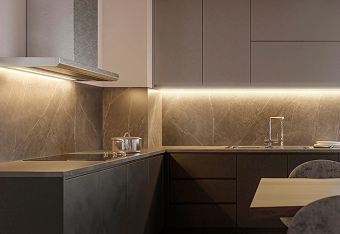
Channel profiles include surface-mount, recessed, and corner options, each matched to a different installation condition. A diffuser lens softens the point-by-point output of individual diodes into a continuous band of light. This is the intended finish for any strip in the direct line of sight. For indirect applications like cove lighting, where the strip is hidden from view, a diffuser is less critical.
Select the channel and lens option based on whether the strip will be visible to occupants in normal use. Include both in the specification from the start. A channel and diffuser that are absent from the original spec often get removed during procurement, and the omission is obvious in the finished installation.
Warranty Terms
Warranty lengths for LED strip lighting vary widely across the market. A one-year warranty and a ten-year warranty on two strip products at a similar price point are not equivalent choices. The terms reflect the manufacturer's confidence in the product's lasting performance under real installation conditions.
For commercial and hospitality projects, this matters beyond the design phase. A strip that fails in year two or three requires repair conversations that no designer wants to have with a client. Specifying products with stronger warranty coverage protects the finished project and the relationship with the client well past the project's completion.
The strip warranty and the driver warranty should be separate specifications. Driver longevity is often the limiting factor in the long-term performance of a durable LED light strip system. Driver warranties tend to be shorter than strip warranties across the industry. Confirm both terms before finalizing the spec, and factor them into product comparisons the same way you would factor in CRI or CCT.
System Compatibility
The strip is one component in a complete system that includes a driver, a controller or dimmer, mounting channels, connectors, and wiring. Specifying the strip and treating everything else as a procurement detail is one of the most consistent sources of installation problems on professional LED lighting projects.
Issues with wattage, controllers, or pin connector mismatches are predictable results of specifying a component without specifying the system it belongs to.
Treat the strip specification as the starting point of a complete bill of materials. Confirm compatibility across all components before placing the order, and build that confirmation step into your standard process for every LED strip project.
Specification as Design Protection
LED strip lighting gives designers tremendous control over how a space feels. Getting that control to survive from concept to finished installation and beyond means accounting for several often-overlooked details. Each of these variables is manageable when addressed before the product ships. Doing this protects the design and provides quality lighting that lasts.