
7 Lighting Mistakes That Ruin Commercial Spaces
Proper lighting is a great way to highlight a well-designed commercial space. A modest space with a thoughtful LED light installation can feel refined and intentional. The flip side is also true. Poor lighting choices detract from the intended design. Finishes, millwork, and architectural details that read well in concept often fall flat under the wrong light.
The difference between these two outcomes usually comes down to a handful of avoidable specification decisions. These seven mistakes show up regularly in commercial and hospitality lighting installations. All of them are preventable.
Mistake 1: Overlighting the Space
Brighter isn't better in most commercial applications. A room that’s uniformly and intensely lit tends to feel institutional rather than inviting. This is the wrong outcome in restaurants, bars, hotels, and upscale retail environments. Overlighting also flattens depth: a space without shadow play, contrast, or visual hierarchy has no dimension, regardless of how much is invested in the design.
The solution isn't always a lower lumen output but a better lighting strategy. A layered plan that combines ambient, task, and accent lighting at different levels creates visual interest at a fraction of the total lumen load of a single-source approach. Dimming controls let the client shift output across different service periods without any hardware change.
Mistake 2: Choosing the Wrong Color Temperature
Color temperature affects how a space feels more than almost any other lighting decision. A 5000K to 6500K source is sharp, alert, and blue-white. This temperature works in a warehouse, a clean room, or a task-intensive commercial kitchen. It doesn't belong in places like a restaurant dining room or hotel lobby.
Most hospitality and commercial interior applications call for a range of 2700K to 3500K. Warmer tones read as more inviting, more flattering on skin, and more consistent with the ambient feel most designers are working toward in these spaces. If the space serves different purposes throughout the day, tunable white LED strips are a simple solution that lets you adjust the color temperature as needed, all from a single fixture.
Mistake 3: Skipping Mounting Channels
LED strips installed without mounting channels are a visible problem. The adhesive backing alone isn't a finished installation. Strips mounted directly to a surface without a channel leave the diodes, substrate, and wiring exposed, which reads as incomplete in almost any interior application.
Mounting channels serve three purposes. They protect the strip, direct light output, and create a clean, finished look that communicates intention. Channel profiles are available in surface-mount, recessed, and corner options, each matched to a different installation condition.
For cove lighting, a recessed channel keeps the strip flush with the cove surface. For under-cabinet or shelving applications, a surface-mount channel with a diffuser lens softens the individual diodes into a continuous band of light.
Channel choice should be considered from the start of your lighting plan.
Mistake 4: Placing Strips Poorly
Where a strip sits determines what it does. Strips mounted too close to the surface they are meant to illuminate, create intense hot spots directly above the diodes. They fade sharply on either side. Strips aimed in the wrong direction illuminate the wrong plane entirely. When LED strips are positioned too deep in a cove channel, the light is emitted at a steep angle. That means it never spreads evenly across the lit surface.
Cove lighting requires enough depth in the cove to allow the light to spread before it enters the field of view. Under-cabinet strips should be positioned toward the front edge of the cabinet to illuminate the countertop rather than the backsplash. Feature wall accent strips should be placed and aimed so the wash is consistent from top to bottom.
Avoid these placement issues with straightforward corrections during the design phase. They are very difficult and costly to address after installation.
Mistake 5: Using Inconsistent Color Temperature Across Zones
A space using 2700K LED strips in the cove, 3500K fixtures at the bar, and 4000K pendants above the tables will feel off, even if no individual source looks wrong in isolation. Color temperature inconsistency across lighting zones creates a visual tension that most occupants may not identify, but will feel.
Specify color temperature as a system decision, not a fixture-by-fixture one. Set the target correlated color temperature (CCT) at the design stage and hold every source to it. Carefully consider any variation and use only when the design explicitly calls for a special effect. When multiple vendors or product types are involved in a single space, verify the color temperature specification for each product before placing an order.
Mistake 6: Installing Lighting Without Dimming Controls
A commercial space without dimming is locked into a single mood. That may work in some contexts, but it is a significant limitation in many situations. Places like restaurants, bars, event venues, and hotel lobbies have different lighting needs depending on the time of day or how the room is being used.
Dimmable LED lights require compatibility between the strip, the driver, and the dimmer. A mismatched system produces flickering at low brightness levels, a limited dimming range, or a sudden dropout before the control reaches zero. Specify the dimmer and driver together, not as separate line items.
A compatible combination that supports smooth, flicker-free output across the full dimming range costs less to specify correctly upfront than it does to replace or reconfigure after your client reports a problem.
Mistake 7: Ordering Strips Without a System
An LED strip is one component in a larger system that includes a driver, a controller or dimmer, mounting channels, connectors, and wiring. Choosing only the strip and treating everything else as details to be sorted out later is one of the most reliable ways to generate installation problems.
An undersized driver overheats and fails. A controller incompatible with the strip type produces control errors or no output. Connectors that don't match the strip's pin count or width won't seat correctly.
These are not edge cases. They are the predictable result of specifying a component without specifying the system it belongs to. Confirm component compatibility across the full bill of materials before the order is placed, not after the product arrives on site.
Specifications Protect Your Finished Project
These lighting mistakes aren't the result of careless design. Most stem from not clarifying the details enough to ensure the design intent survives installation. You should decide on the right color temperature, dimming setup, channel selection, and component compatibility before the first strip is pulled from the box. That approach ensures your commercial space will have the cohesive, effective lighting solutions it needs to thrive.
Video
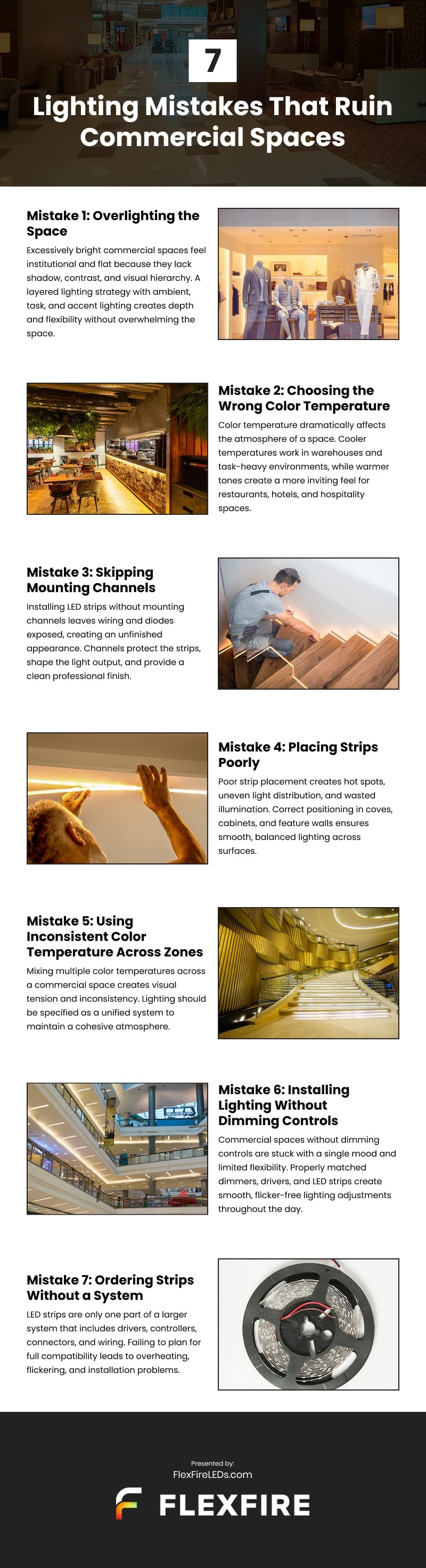
Infographic
Lighting is essential for creating the atmosphere and functionality of commercial and hospitality spaces. Poorly planned or inconsistent lighting can diminish even the best interior designs. Check out this infographic for common lighting mistakes that can harm commercial spaces.